GOD’S OWN ARMY
The Puranas, ancient Sanskrit texts of Hinduism, tell the story of the divine being Darika who, through devout religious practices, convinces Lord Brahma to make him invincible to any man. His ego inflated by these newly acquired powers, Darika goes on a rampage, committing numerous crimes. This infuriates Lord Shiva who, upon receiving word of Darika’s misdeeds, creates the fierce goddess Bhadrakali out of his third eye and orders her to destroy Darika. Arrogant and blinded by power, Darika ridicules Shiva’s envoy, completely forgetting that Brahma’s boon excludes female adversaries. Bhadrakali kills Darika in a fierce battle and returns to Mount Kailash, Shiva’s abode, with Darika’s head in her left hand.
The Silappatikaram, the great 2nd century epic of Tamil literature, tells the story of Kannaki, a young merchant’s daughter who, together with her husband Kovalan, goes to town trying to sell one of her two ruby anklets. While Kannaki participates in a tribal festival, Kovalan ends up being accused of stealing an anklet belonging to the queen and the hapless man is consequently beheaded. Upon hearing of her husband’s death, Kannaki, filled with rage, confronts the king. She throws down her other, identical, anklet, spilling the red rubies inside, thereby proving her husband’s innocence. Then she sets the city on fire. Proclaimed a devi (goddess) by the local tribal women, Kannaki retreats to Kodungallur, where she attains samadhi, the realization of oneness.
Travel to the Sri Kurumba Bhagavati Temple in Kerala, India.
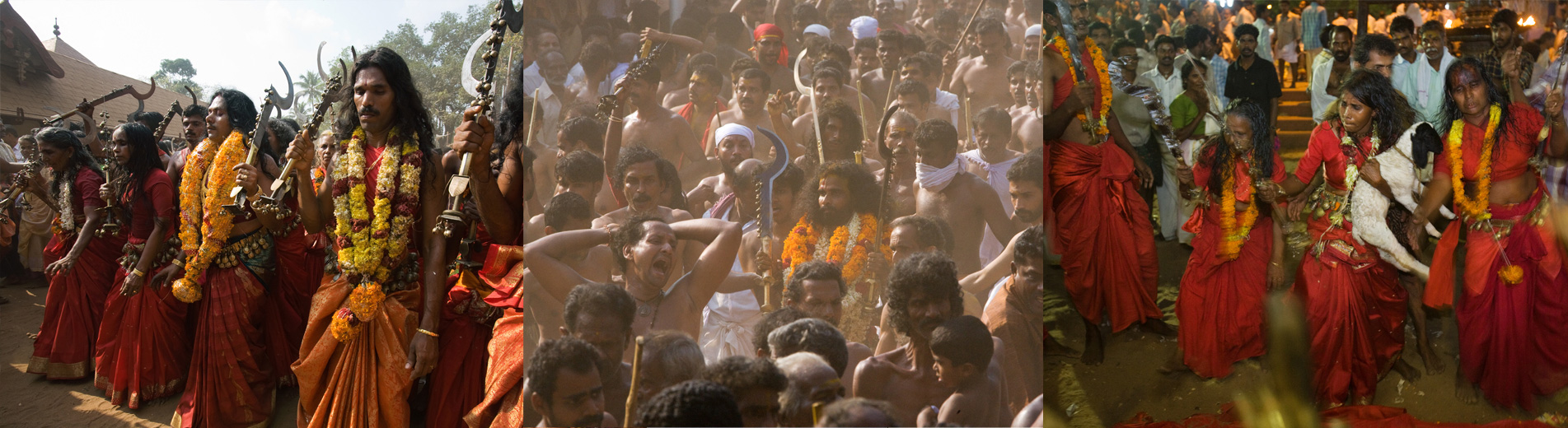
South India has a long tradition of goddess worship, nowhere expressed as fervently as in Kodungallur, the former capital of the ancient Cera kingdom. Every year, from the Bharani day in the Malayalam month of Kumbhan to the Bharani day in the following month of Minam, the Sri Kurumba Bhagavati Temple, also known as the Kodungallur Devi Temple, becomes the setting for a unique and controversial celebration; the Kodungallur Bharani.
Thousands of worshippers, mainly from the lower-caste communities, flock to the temple to profess their devotion to Kodungallur Bhagavati, the goddess, represented as both Bhadrakali and Kannaki. Oracles called Velichappadus (literally “vehicles of light”), enter a trance and, in a devotional act of self-flagellation, draw blood by hitting their foreheads with the pallival, a ceremonial sickle-tipped sword which is a symbol of Kali.
On the Bharani day of Minam, the festival culminates in the Khavu Theendal ceremony, the ritual pollution of the temple. Frenzied crowds of pilgrims and oracles join in a mad race, three times circumnavigating the inner sanctum of the temple, waving swords and sticks and hurling bags of turmeric powder into the temple. The singing of theripaatu, obscene and sexually suggestive songs, an integral part of the entire festival, intensifies during Khavu Theendal.
Heavily criticized by members of the Brahmin caste who have spearheaded attempts at banning this ribald expression of devotion for the Goddess, worshippers maintain that Bhagavati is pleased by their unwavering affection.
As a celebration relatively free from the moralistic constraints of upper-class religious gatekeepers, the Kodungallur Bharani remains for now a riotous expression of divine unity.
© Hans Kemp, 2019